
Why a Clean Core Creates Lasting Speed
How Clean ERP Cores Enable Sustainable Speed-to-Value
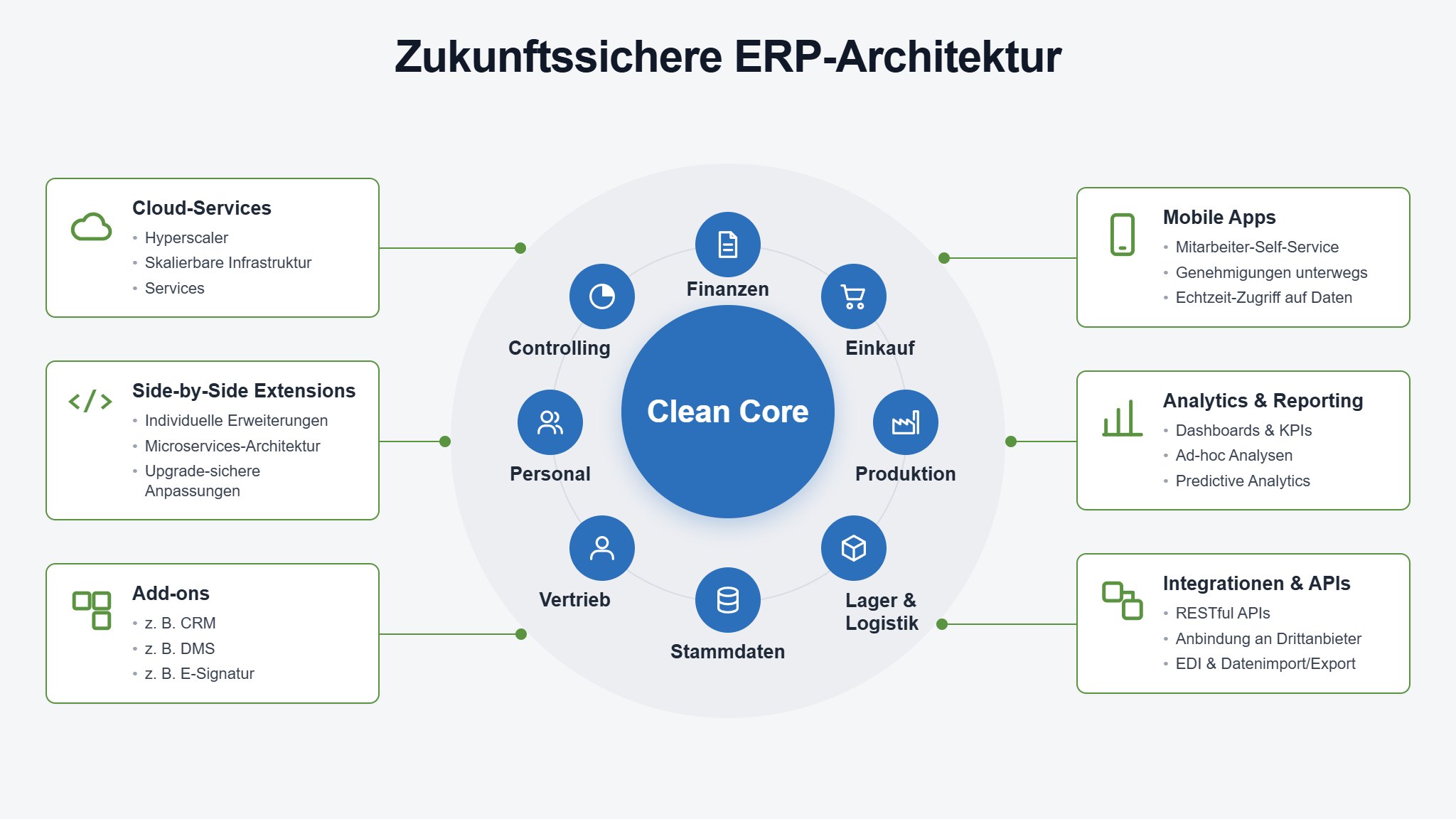
Speed is one of the most important goals in modern ERP transformations. How much of it is actually achieved often only becomes clear in day-to-day operations, when new requirements arise and systems have to evolve.
A Clean Core helps companies keep their ERP landscape manageable and develop it continuously. An ERP core that stays close to standard makes it easier to adopt new features, reduces complexity and creates the basis for sustainable speed-to-value.
Speed Is More Than a Fast Go-Live
The speed of an ERP transformation shows above all after go-live, when new requirements arise, processes need to be adapted or additional functions are to be used.
In many companies, the success of an ERP implementation is initially measured by how quickly the new system can be used productively.
How quickly did we go live?
That question is understandable. ERP implementations involve considerable effort, and go-live marks an important milestone. The real test, however, often only begins in day-to-day operations, because companies keep developing, markets change and new requirements arise continuously.
For long-term agility, what matters is therefore:
- how quickly processes can be adapted after go-live
- how much effort new requirements take to implement
- how reliably updates and extensions work
Sustainable speed-to-value arises where new requirements can be turned into concrete results without excessive effort.
What Clean Core Really Means
Clean Core creates a clear separation between the ERP core and individual extensions so that systems remain manageable and capable of further development in the long term.
Clean Core is an architectural principle in which the ERP core remains as free as possible from individual modifications. Extensions are delivered through defined interfaces and platforms outside the core system. This allows companies to adopt innovations faster, take on updates more easily and reduce the complexity of their ERP landscape.
At its heart, it is about using standards consistently and implementing individual requirements where they do not compromise the stability of the ERP system.
In practice, this means:
- no deep modifications to the core system
- use of standard processes wherever sensible
- clear separation between core, extensions and integrations
The ERP core thus becomes a reliable foundation rather than a bottleneck.
Why a Dirty Core Destroys Speed
The more the ERP core is customised, the harder future changes become. Speed is increasingly limited by complexity.
In practice, this often only becomes apparent when companies have to respond to new requirements.
A business requirement changes — for example because a new business unit is to be integrated, additional reporting requirements arise or a new site is connected.
Although the functional change is often modest, it quickly turns into a project lasting several weeks. Customisations that have grown in the ERP core over the years have to be analysed, dependencies assessed and extensive tests carried out.
Every change requires additional coordination between business departments, IT and external partners. Flexibility created in the short term gradually turns into complexity that slows down change and limits the company’s ability to react.
The effects are not limited to individual requirements. As complexity grows, so does the effort required for updates and for introducing new functions. What was originally planned as routine development often becomes a project lasting months or even years. In extreme cases, necessary updates are postponed again and again or avoided altogether because the effort is no longer economically manageable.
Individual modifications to the ERP core often seem pragmatic in the short term.
In the long run, however, they lead to:
- increasing technical complexity
- costly testing with every change
- delayed updates and innovation
- growing dependency on specialist knowledge
| Area | Clean Core | Dirty Core |
|---|---|---|
| Speed of change | New requirements can be implemented faster and in a more controlled way. | Changes require more coordination, analysis and safeguarding. |
| Updates | New releases can be adopted regularly. | Updates often turn into costly projects. |
| Innovation | New functions become available to the business faster. | Innovations are often postponed or introduced late. |
| Process standardisation | Uniform processes create consistency and transparency. | Individual special solutions lead to diverging process variants. |
| Scalability | New sites, entities or business models can be integrated more easily. | Growth increases complexity and integration effort. |
Table: Clean Core vs. Dirty Core
With every intervention in the core, the ability to react quickly diminishes. Speed is replaced by caution, and innovation by fear of instability.
Clean Core as a Prerequisite for Continuous Development
A Clean Core makes it easier to use new functions, because existing extensions have less influence on how the system develops.
ERP systems, and cloud-based ERP solutions in particular, evolve continuously. New features, regulatory updates and technological improvements become available on a regular basis.
A clean core enables:
- seamless adoption of updates
- predictable innovation cycles
- reduced testing and adaptation effort
- faster adoption of new features
If core processes are largely mapped in the standard, new functions can usually be adopted with significantly less effort.
Speed Comes From Clear Architectural Decisions
Long-term speed comes from deliberate decisions about what should be standardised and what should be extended.
Many of the decisions that shape how the ERP landscape develops later are made during the transformation itself. They determine how future requirements are handled and how flexibly the system landscape can evolve.
The central questions include:
- Which processes must remain standardised?
- Where does genuine differentiation occur?
- Which extensions deliberately belong outside the ERP core?
Those who clarify these questions early avoid many later discussions about exceptions, special solutions and individual extensions.
Clean Core Requires Leadership and Discipline
A Clean Core is created through clear guardrails, consistent decisions and governance that holds up in day-to-day work.
Companies repeatedly face the question of when individual requirements create real added value and when existing standards are sufficient.
What matters, therefore, is:
- using standards consistently where they meet the functional requirements
- questioning exceptions critically and justifying them transparently
- defining clear responsibilities for decisions and further development
The effects of these decisions often only become visible when new requirements are implemented or existing processes are adapted. That is when it becomes clear how well the ERP landscape can handle change.
Rethinking Speed-to-Value
Speed-to-value means realising benefits faster and with less friction, not implementing as many changes as quickly as possible.
To achieve this, speed-to-value should above all aim to:
- make value visible earlier
- implement change with minimal effort
- preserve the company’s adaptability in the long term
This understanding of speed adds a long-term perspective to ERP transformations.
Conclusion: A Clean Core, Lasting Speed
Key takeaways
- A fast go-live alone does not create sustainable speed.
- Clean Core reduces technical and organisational complexity.
- ERP cores close to standard make updates and innovation easier.
- Speed comes from deliberate architectural decisions.
- Governance and strong leadership are decisive success factors.
- Sustainable speed-to-value is based on long-term adaptability.
ERP systems evolve over many years. New requirements, organisational change and growth place ever new demands on the system landscape.
A Clean Core helps keep the resulting complexity manageable. Processes close to standard and clearly separated extensions make change, updates and the adoption of new functions easier.
The decisions made during an ERP transformation often continue to have an effect for many years after go-live. That makes it all the more important to consider long-term adaptability from the outset.


